The Assessor annually notices and administers over 1.8 million real and personal property parcels and accounts with a full cash value of more than $1 trillion.
Property owners in Maricopa County will now have a faster, more convenient way to communicate with the Assessor's Office during the property error correction process, thanks to House Bill 2173, which was sponsored by Representative Livingston of Legisl...
Maricopa County Assessor's Office Welcomes New Law Modernizing Communications
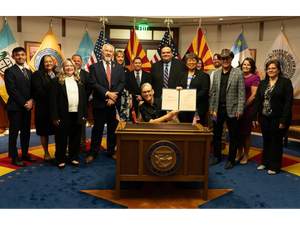
Property owners in Maricopa County will now have a faster, more convenient way to communicate with the Assessor's Office during the property error correction process, thanks to House Bill 2173, which was sponsored by Representative Livingston of Legislative District 28, championed by Maricopa County Assessor Eddie Cook, and signed into law by Governor Katie Hobbs.
Prior to HB 2173, when assessors issued a Notice of Proposed Correction to a property owner, there was no established mechanism for the property owner to respond electronically. Similarly, while property owners could file a Notice of Claim online with the Assessor's Office, the Assessor's Office was required to respond in writing. The new law allows for electronic communication at both ends of the process.
Under the new legislation, property owners who elect to communicate electronically can submit their response to a Notice of Proposed Correction or file a Notice of Claim digitally, rather than through traditional written correspondence. Assessors will be required to provide an electronic acknowledgment of receipt and may also communicate with the owner electronically if the owner opts in. All existing deadlines and procedural requirements remain in place, and any communications required to be served by certified mail will continue to follow that process.
"Our office is committed to making it easier for property owners to interact with us, and HB 2173 is a step in the right direction," said Maricopa County Assessor Eddie Cook. "Our customers expect to be able to communicate digitally, and this law helps us meet them where they are."
HB 2173 is part of the Maricopa County Assessor's Office's broader Digital First initiative, which aims to modernize operations and improve accessibility for the 4.6 million residents the office serves.
Assessor's Office Earns National Top Workplace Award
The Maricopa County Assessor’s Office is proud to announce it has been named one of the country’s Top Workplaces.
The office recently received the prestigious 2026 USA TODAY Top Workplaces award, which honors organizations with 150 or more employees that have created exceptional, people-first cultures. This national recognition comes after the Maricopa County Assessor’s Office was named one of AZ Central’s Top Workplaces in Arizona for 2025 and received five Workplace Culture Excellence awards.
Both the AZ Central and USA TODAY Top Workplace award winners were selected based on authentic employee feedback captured through a confidential survey conducted by the third-party HR research and technology company, Energage.
“I am so proud of our team and the ONE TEAM culture they have created and nurtured that makes our office a Top Workplace not only in Arizona, but in the entire country,” said Maricopa County Assessor Eddie Cook. “This award is a testament to the excellence, care, and dedication that each of our team members brings to our organization every day.”
Arizona Passes Landmark Legislation to Protect Homeowners from Deed Fraud
Arizona homeowners will now have stronger protections against the growing threat of title and deed fraud thanks toSenate Bill 1479, which received unanimous support in the Arizona Senate and has been signed into law by Governor Katie Hobbs.
This comprehensive bipartisan measure was sponsored by Senator Frank Carroll, co-sponsored by Representatives Selina Bliss and Patricia Contreras, and championed by Maricopa County Assessor Eddie Cook, county agencies across Arizona, the Governor’s Office, the Attorney General’s Office, and industry stakeholders.
This pivotal legislation introduces several major reforms to Arizona’s property system, like closing legal loopholes and imposing stricter penalties on those who exploit them, to better safeguard property owners from becoming victims of deed fraud - an issue that has surged nationwide.
With a forged signature and fraudulently recording property documents, criminals can unlawfully transfer ownership or attempt to leverage property that doesn’t belong to them, oftentimes before the true owner even realizes that their property has been sold, leaving them with costly legal battles to reclaim what they already own. It’s a crime that can target anyone – first-time homebuyers, seniors, and families.
“A home is often a family’s most important investment, both financially and emotionally,” said Maricopa County Assessor Eddie Cook. “Deed fraud robs people of far more than property; it steals their sense of security. SB 1479 puts real guardrails in place to protect Arizona homeowners, and I’m proud our office helped lead this effort.”
With the passage of SB 1479, Arizona will now lead the nation in making deed fraud more difficult by directly addressing the threat through six key components.
Mandatory Photo ID for In-Person Recording
Anyone recording a document in person at a county recorder’s office must present valid photo identification, with limited exceptions for trusted industry professionals such as escrow officers, attorneys, and financial institutions.
Statewide Property Owner Alert System
County assessors must create an opt-in alert system by January 1, 2027, to notify property owners whenever ownership of their property changes or the mailing address on record changes. This early-warning system will help owners respond to fraud attempts before damage is done.
Strengthening the Affidavit of Legal Value
Buyers and sellers must now provide mailing addresses and phone numbers, with an option to include email addresses, on an Affidavit of Legal Value, giving officials and owners better tools to confirm legitimate transfers.
Higher Penalties for Filing False Real Estate Documents
Submitting false property documents will now be a Class 5 felony, upgraded from a Class 1 misdemeanor, reflecting the severity and financial harm caused by deed fraud.
Repeal of A.R.S. § 12-524
SB 1479 repeals the law at the center of the recent Arizona Supreme Court Case, Dominguez v. Dominguez, which could allow a forged deed to stand as valid if it went uncontested for five years. This fixes that issue and helps ensure forged documents cannot gain legitimacy through legal loopholes.
New Notary Thumbprint Requirement
Notaries must now obtain a thumbprint in their journal for most deeds and other real estate documents. Remote notarizations are exempt only if a video recording verifies the signer’s identity and is retained for at least seven years.
Combating deed fraud has been a top priority for Cook and the Maricopa County Assessor’s Office since 2024. Last year, the Assessor’s Office hosted a Title Deed Fraud Seminar, which brought together industry experts, county officials, and state lawmakers to better understand the increasing issue of deed fraud and devise proactive measures to deter it. Cook said these strong partnerships and collaborations were key to the bill’s success.
“Together, we created practical, meaningful solutions that will have an immediate impact in preventing fraud and strengthening public trust,” said Cook. “This legislation provides the early alerts, verification safeguards, and legal teeth we need to stop criminals before harm is done.”